Bath's unique architectural landscape — from Georgian crescents to converted warehouse apartments — means the city has one of the highest concentrations of wireless fire alarm systems in the South West. Whether your system uses Hochiki Ekho, Apollo XPander, EMS FireCell, Cygnus, or Hyfire protocols, professional maintenance is not optional — it's a legal requirement under BS 5839-1 and the Regulatory Reform (Fire Safety) Order 2005. Finding a local, certified engineer who understands wireless-specific maintenance is essential.
Why Wireless Systems Need Specialist Servicing
Wireless fire alarm systems share the same fundamental maintenance requirements as hardwired systems — but they have additional maintenance considerations that many general fire alarm contractors overlook:
- Battery lifecycle management — Every wireless detector, call point, sounder, and interface module runs on batteries. While manufacturers quote 5–8 year battery life, real-world performance depends on environmental conditions, signal path complexity, and supervision frequency. Planned battery replacement is critical to prevent system failures
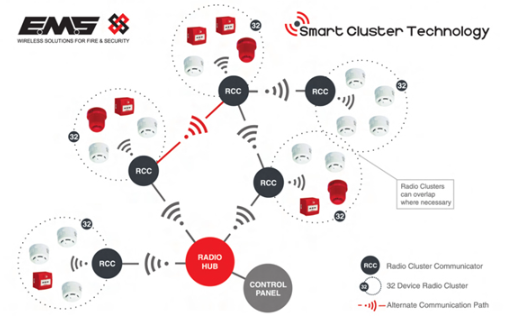
- RF signal path verification — Wireless devices communicate via radio frequency mesh networks. Building modifications, new furniture, electromagnetic interference from other equipment, and even seasonal changes (foliage growth near external walls) can affect signal propagation. Signal path testing must be part of every service visit
- Firmware updates — Wireless panels and devices may require firmware updates to address security vulnerabilities, improve performance, or maintain compatibility with monitoring systems
- Mesh network health — In a mesh network, each device acts as a relay for others. If one device fails or is removed, the mesh reconfigures — but this can create single points of failure if not monitored. System health checks must verify mesh redundancy
- Environmental monitoring — Wireless detectors are more sensitive to environmental contamination (dust, insects, cooking fumes) because battery-powered devices cannot use active airflow management. Regular cleaning and sensitivity testing is essential
BS 5839-1 Maintenance Requirements
BS 5839-1 specifies the same maintenance frequencies for wireless systems as for hardwired systems, with wireless-specific additions:
Weekly Testing
- Test at least one manual call point per week on a rotating basis, so every call point is tested over a 13-week cycle
- Verify that the panel receives the alarm signal and activates sounders correctly
- Check for any fault conditions on the panel, including low battery warnings and RF communication faults
- Record all test results in the fire alarm log book
Quarterly Inspection (by a Competent Person)
- Visual inspection of all devices for physical damage, contamination, and correct positioning
- Battery voltage check on a sample of wireless devices
- RF signal strength test — verify that each device maintains adequate signal quality to at least two mesh neighbours
- Panel fault log review — investigate and resolve all logged faults
- Functional test of a representative sample of automatic detectors (typically 25%)
- Check all cause-and-effect functions (e.g., door holder release, emergency lighting activation)
Annual Service (by a BS 5839-1-Certificated Contractor)
- Full functional test of every automatic detector using appropriate test equipment (smoke capsule, heat source, or CO test gas depending on detector type)
- Full functional test of every manual call point, sounder, and visual alarm device
- Comprehensive RF site survey to identify any degradation in signal coverage
- Battery condition assessment across all wireless devices with replacement recommendations
- Panel software and firmware version check
- Verification of monitoring centre connectivity (if applicable)
- Update of as-built drawings if any devices have been added, moved, or replaced
- Issue of BS 5839-1 service certificate
Common Wireless Fire Alarm Faults
Our Bath-based engineers regularly encounter these wireless-specific issues during service visits:
| Fault | Cause | Resolution |
|---|---|---|
| Low battery warning | Battery approaching end-of-life or excessive supervision polling | Planned battery replacement; review supervision intervals |
| RF communication fault | Building modification blocking signal path, new interference source | RF site survey, add repeater or relocate device |
| Detector contamination | Dust, insects, or cooking fumes entering optical chamber | Professional cleaning or detector head replacement |
| False alarms | Incorrect detector type for environment, sensitivity drift | Detector type review, sensitivity adjustment, possible relocation |
| Mesh network degradation | Device removed without mesh impact assessment | Mesh network reconfiguration, additional relay devices |
Battery Replacement Planning
Battery management is the single most important difference between wireless and hardwired fire alarm maintenance. A proactive approach prevents unexpected system failures:
- Installation date tracking — Every device's battery installation date should be recorded. We maintain a battery lifecycle register for every system we service
- Batch replacement — Rather than replacing batteries reactively as they fail, planned batch replacement at 5-year intervals (or manufacturer-recommended intervals) is more cost-effective and eliminates the risk of cascading failures
- OEM batteries only — Wireless fire alarm devices must use manufacturer-specified batteries. Using non-OEM batteries can affect device performance, void warranties, and potentially compromise fire safety
- Disposal compliance — Lithium batteries from wireless fire alarm devices must be disposed of in accordance with WEEE Regulations. We handle all battery disposal through licensed waste carriers
Wireless Systems We Service in Bath
Affinity Fire & Security engineers are trained and certified to service all major wireless fire alarm platforms installed across Bath's heritage and commercial properties:
- Hochiki Ekho — Addressable wireless system with mesh networking and 8-year battery life
- Apollo XPander — Wireless detectors and interfaces compatible with Apollo addressable panels
- EMS FireCell — Purpose-designed wireless fire alarm system with hybrid wired-wireless capability
- Cygnus — Wireless alarm system widely used in construction and temporary applications, also installed in some permanent heritage settings
- Hyfire — Wireless fire alarm system with mesh networking and extensive device range
The Responsible Person's Legal Obligations
Under the Regulatory Reform (Fire Safety) Order 2005, the responsible person must ensure the fire alarm system is maintained in efficient working order. For wireless systems in Bath, this means:
- Appointing a BS 5839-1-certificated contractor for all servicing
- Ensuring weekly testing is carried out and recorded
- Scheduling quarterly and annual inspections in accordance with BS 5839-1
- Maintaining the fire alarm log book with all test results, faults, and engineer visit records
- Acting on any fault conditions promptly — a wireless system with a known fault that is not addressed may constitute a breach of fire safety law
Why Choose Affinity Fire & Security for Wireless Fire Alarm Servicing in Bath?
As a specialist contractor working to BS 5839-1, backed by a team with 25+ years of industry experience, We provide specialist wireless fire alarm servicing across Bath, Somerset, and the wider South West. Our engineers hold manufacturer certifications for all major wireless platforms and understand the unique challenges of maintaining systems in Bath's listed and heritage buildings.
We offer flexible planned preventative maintenance contracts covering all wireless fire alarm servicing requirements, including battery lifecycle management, RF signal path monitoring, and emergency call-out cover. Get in touch with our team for a free maintenance quotation and system health check.
Talk to a Local Engineer
If you would like honest advice, a clear written quote, or help with compliance paperwork,get in touch with our team. We are a small, experienced South West team, and we look after every customer properly — no pushy sales, no hidden extras, and documentation you can rely on.