Not every fire risk can be managed by a conventional sprinkler head or a hand-held extinguisher. Modern commercial buildings across the UK contain concentrated hazards — deep-fat fryers, low-voltage distribution boards, lithium battery storage, plant rooms and heritage interiors — where the wrong extinguishing medium can be as damaging as the fire itself. Specialist fire suppression sits above traditional protection: it is engineered around the specific fuel, ignition source and building fabric it defends.
High-Performance Water Mist Systems
Water mist suppression, designed and installed to BS 8489 and BS 8458, atomises water into microscopic droplets that flash to steam on contact with fire. This provides three effects in one discharge: rapid cooling, oxygen displacement in the flame zone, and radiant heat blocking. The result is fire knock-down using a fraction of the water a sprinkler system requires — typically 80–90% less.
- Reduced water damage: critical in listed buildings, hotels, data halls, museums and residential blocks where secondary damage often exceeds fire damage
- Smaller pipework and tanks: easier to route through occupied and historic structures without disruptive builders' work
- Machinery space protection: approved for engine rooms, gensets, turbine enclosures and CHP plant
- Residential high-rise applications: a proven alternative where a BS 9251 sprinkler retrofit is impractical
Electrical Panel & Distribution Board Protection
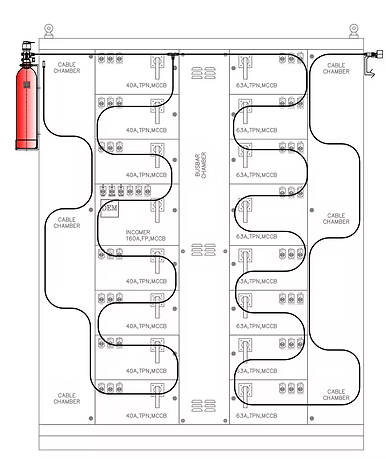
Faulty electrical distribution equipment is the single largest ignition source in UK commercial building fires — the Home Office's Fire and Rescue Incident Statistics consistently attribute more non-dwelling fires to electrical distribution than to cooking, arson or smoking combined. A live distribution board, sub-mains panel or inverter cabinet is a sealed metal box full of hot copper: by the time smoke reaches a ceiling-mounted detector, the arc fault inside has already destroyed the switchgear and often ignited surrounding cable insulation.
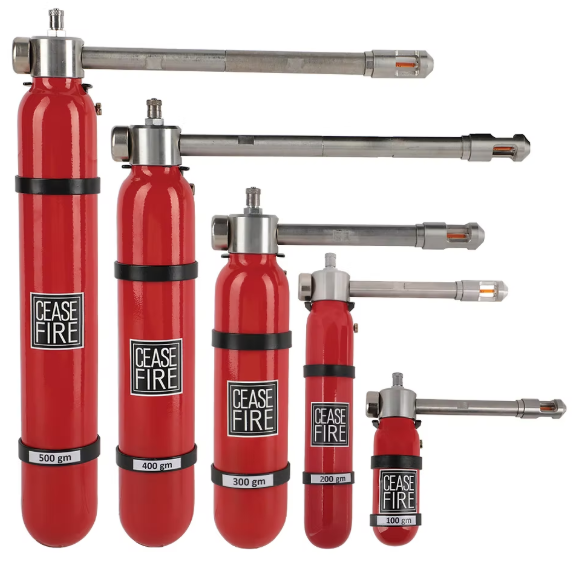
In-cabinet suppression solves this at source. A pneumatic detection tube — pressurised, temperature-sensitive polymer — is routed through every cable chamber, busbar section and heat-rise zone inside the panel. When the tube reaches its rupture temperature (typically 110 °C) it bursts at the exact point of the fire and either discharges agent directly through the hole (direct low-pressure systems) or triggers a valve on a fixed nozzle array (indirect systems). Either way, detection and discharge are localised, automatic and completely independent of the building fire alarm.
- Protects the assets electrical fires actually start in: LV distribution boards, sub-mains panels, PV and battery inverters, EV charger cabinets, UPS enclosures, motor control centres and server-rack PDUs
- Clean-agent discharge: non-conductive, non-corrosive, leaves no residue on live busbars — the panel returns to service the moment the fault is repaired
- Zero infrastructure burden: standalone operation, no mains power, no cabling back to the fire panel, no building works
- Insurance-recognised: increasingly required by underwriters for high-value sites, listed buildings, unmanned plant rooms and PV/battery installations
- Retrofit-friendly: installed into existing panels without invalidating the OEM certification of the switchgear itself
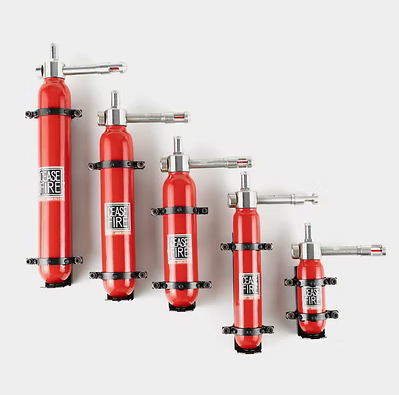
Because activation is contained inside the enclosure, an in-cabinet system typically extinguishes an incipient electrical fire before the building fire alarm has even registered smoke — preventing the classic escalation from panel fault, to cable-tray fire, to full compartment involvement. For any site where downtime is unacceptable, or where a single distribution board sits above stock, records, tenants or heritage fabric, it is now the most cost-effective single piece of fire protection you can specify.
Commercial Kitchen Suppression
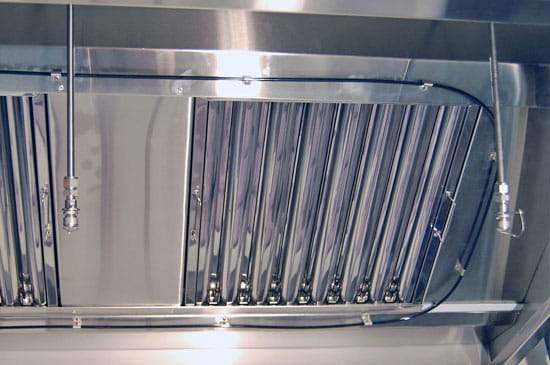
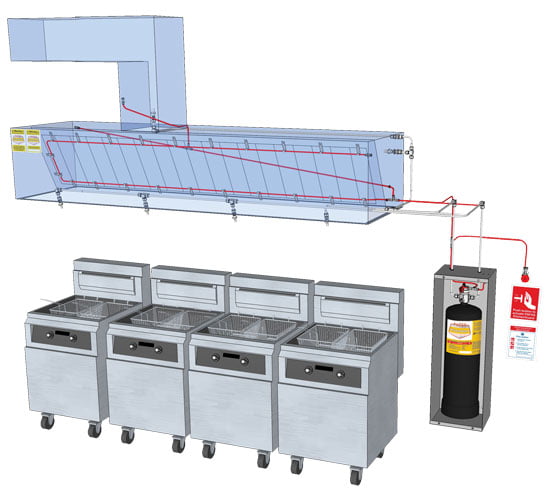
Cooking oil fires burn far hotter than a standard Class A fire and re-ignite readily once cooled. UL 300 and LPS 1223 listed wet chemical systems discharge a potassium-based agent directly across the cooking surface and into the extract canopy, saponifying the oil into a soap-like crust that smothers the fuel and prevents re-flash.
- Automatic detection via fusible links above ranges, woks and fryers
- Simultaneous gas shut-off valve activation to isolate the fuel supply
- Manual pull-station at the kitchen exit route for staff intervention
- Six-monthly service regime aligned with BS 6173 gas safety inspection
Why Specify with Affinity Fire & Security
We design, installs and maintains specialist suppression across the South West. Every system is calculated to BS EN 15004 or the relevant listed standard, commissioned with room integrity testing where required, and supported by our specialist engineering team. From a single kitchen canopy in a Bath restaurant to a full water-mist scheme for a Bristol residential tower, we match the suppression medium to the risk — not the other way around.
Talk to a Local Engineer
If you would like honest advice, a clear written quote, or help with compliance paperwork,get in touch with our team. We are a small, experienced South West team, and we look after every customer properly — no pushy sales, no hidden extras, and documentation you can rely on.