Bath is one of the most architecturally significant cities in England — a UNESCO World Heritage Site where Georgian crescents, Palladian townhouses, and medieval ecclesiastical buildings define the urban landscape. For building owners and managers and responsible persons managing listed and heritage properties in Bath, achieving BS 5839-1 fire alarm compliance without damaging irreplaceable fabric is one of the most complex challenges in fire safety engineering. Wireless fire alarm systems offer the definitive solution.
The Heritage Building Challenge
Conventional hardwired fire alarm systems require extensive cable runs — typically fire-resistant cables routed through walls, ceilings, and risers. In a modern commercial building, this is straightforward. In a Grade I or Grade II listed building in Bath, it can be impossible without causing unacceptable damage:
- Ornamental plasterwork — Bath's Georgian interiors frequently feature original cornicing, ceiling roses, and decorative mouldings that cannot be drilled through or channelled into
- Historic wall finishes — Original lime plaster, panelling, and wallcoverings would be destroyed by conventional cable containment
- Stone facades — Bath stone is soft and porous; drilling and fixing cable trunking to exterior or interior stonework risks permanent damage
- Listed building consent — Any alteration to a listed building's character requires formal consent from Bath and North East Somerset Council (BANES). Intrusive cabling is routinely refused by conservation officers
- Structural limitations — Timber-framed floors, lath-and-plaster walls, and irregular voids make conventional cable routing unpredictable and expensive
These constraints historically forced building owners and managers into an impossible choice: accept a non-compliant fire alarm system or risk damaging the building's heritage value. Wireless technology eliminates this dilemma entirely.
How Wireless Fire Alarm Systems Work
A wireless fire alarm system replaces conventional cable connections between detectors, call points, sounders, and the fire alarm control panel with secure radio frequency (RF) communication. Each device contains its own battery power supply and RF transceiver, communicating with a central hub or directly with the fire alarm panel.
Modern wireless fire alarm protocols are engineered to the same reliability standards as hardwired systems:
- Mesh networking — Devices relay signals through multiple paths, so if one device is obstructed, the signal routes automatically through another. This provides redundancy equivalent to a hardwired loop
- Supervised communication — Every device reports its status to the panel at regular intervals (typically every 10–60 seconds). If a device fails to report, the panel raises a fault condition immediately
- Frequency hopping — The system rapidly switches between multiple RF channels to avoid interference from other wireless devices, Wi-Fi networks, and environmental noise
- Battery life — Modern wireless detectors operate for 5–8 years on a single battery, with low-battery warnings generated months in advance
- BS 5839-1 compliance — Wireless systems are explicitly recognised in BS 5839-1:2025 and can achieve any system category from L1 to L5 and M when properly designed
Wireless System Categories for Heritage Buildings
The system category required for your Bath heritage property depends on the fire risk assessment, not the building's age or listed status. Wireless technology can deliver every category:
| Category | Coverage | Typical Heritage Application |
|---|---|---|
| L1 | All areas | HMO conversions, care homes in period buildings |
| L2 | Escape routes + high-risk rooms | Multi-tenanted offices in Georgian townhouses |
| L3 | Escape routes only | Single-occupancy commercial use |
| M | Manual call points only | Small retail or gallery spaces with supervised occupancy |
Design Considerations for Bath Listed Buildings
Designing a wireless fire alarm system for a listed building requires specialist expertise beyond standard fire alarm design:
- RF site survey — A comprehensive radio frequency survey must be conducted to identify signal propagation characteristics through thick stone walls, timber floors, and metal-lathed ceilings. Bath stone and historic construction materials affect RF transmission differently to modern building materials
- Detector positioning — Devices must be positioned to achieve effective detection coverage while minimising visual impact. Mounting on original features must be avoided — detectors can be placed on non-original surfaces, furniture-mounted brackets, or purpose-designed heritage fixings
- Conservation officer liaison — For listed buildings, the fire alarm design should be discussed with the BANES conservation team at an early stage. A well-designed wireless system is far more likely to receive consent than a hardwired alternative requiring channelling and containment
- Hybrid configurations — Where some areas of the building can accept conventional wiring (e.g., service corridors, modern extensions), a hybrid wired-wireless system can combine the strengths of both technologies
- Sounder coverage — Achieving the required 65dBA/75dBA sounder levels through thick stone walls and heavy timber doors may require additional wireless sounder devices in individual rooms
- Aspirating detection — In spaces where point detectors would be visually intrusive — such as ornate state rooms, chapels, or galleries — aspirating detection using discreet sampling pipes may be appropriate alongside the wireless system
Wireless Fire Alarm Manufacturers We Specify
We work with the leading wireless fire alarm manufacturers to match the right technology to each heritage application:
- Hochiki Ekho wireless system — A fully addressable wireless fire detection system with mesh networking, 8-year battery life, and seamless integration with Hochiki's wired addressable panels
- Apollo — Apollo's wireless detector range using the XPander protocol provides reliable coverage with supervision intervals of 10 seconds and full compatibility with Apollo addressable panels
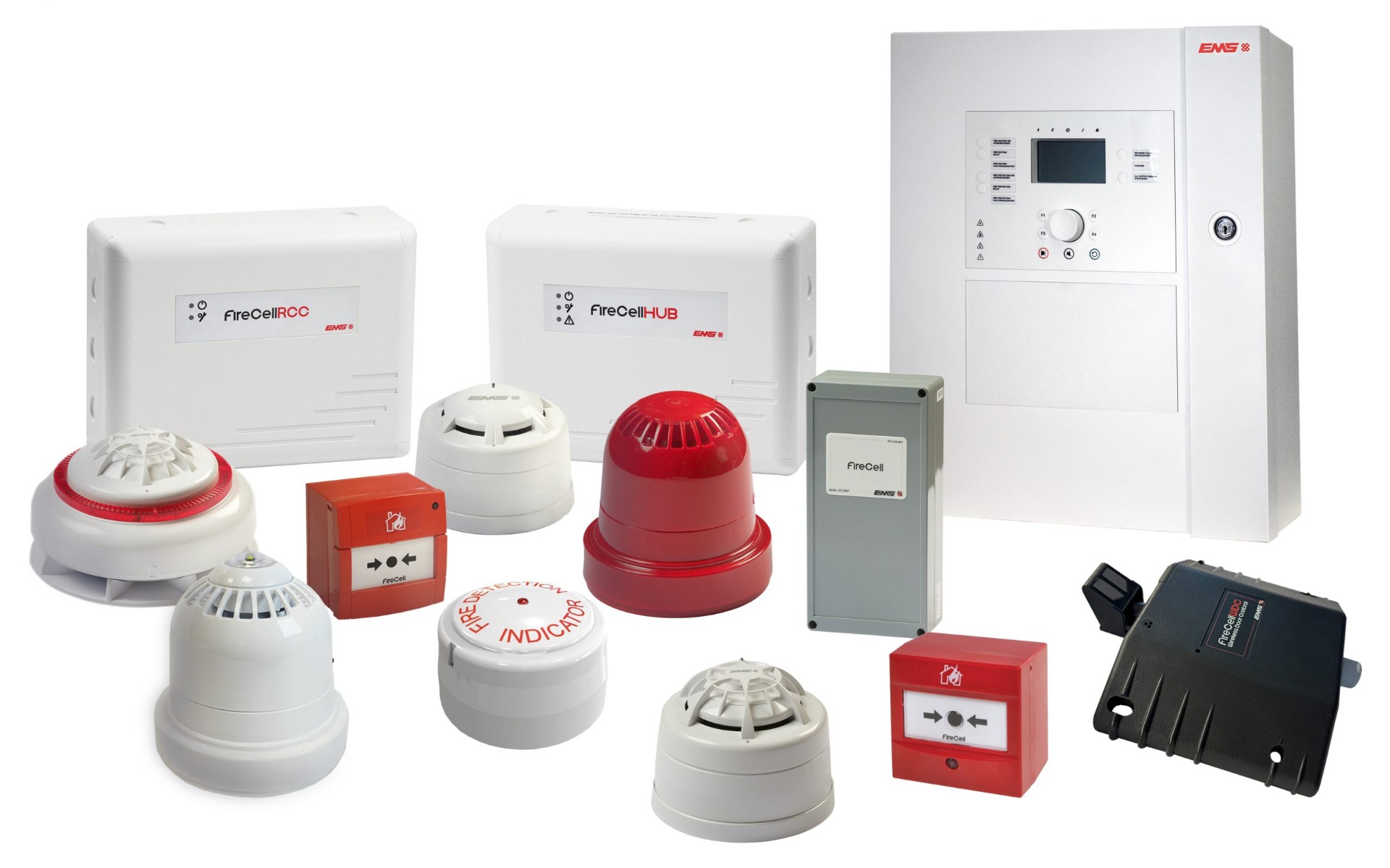
- EMS FireCell — A purpose-designed wireless fire alarm system with mesh networking, hybrid capability, and a range of detectors, call points, sounders, and interfaces specifically engineered for heritage and retrofit applications
Legal Obligations for Heritage Building Owners
Being a listed building does not exempt the responsible person from fire safety law. The Regulatory Reform (Fire Safety) Order 2005 applies equally to listed and non-listed premises:
- A suitable and sufficient fire risk assessment must be completed and reviewed regularly
- The fire alarm system must match the category recommended by the fire risk assessment
- The system must be installed by a competent contractor — ideally BS 5839-1-certificated
- Regular testing and professional servicing must be maintained and documented
- Any building alterations — including fire alarm installation — in a listed building require listed building consent from the local planning authority
Failure to comply with fire safety law can result in enforcement notices, prosecution, and unlimited fines. Separately, carrying out unauthorised works to a listed building is a criminal offence under the Planning (Listed Buildings and Conservation Areas) Act 1990.
What a Wireless Installation Involves
- Heritage assessment and fire risk assessment review — Understanding both the fire safety requirements and the building's heritage constraints, including any existing listed building consent conditions
- RF site survey — Mapping signal strength throughout the building to determine optimal device locations and identify any areas requiring signal repeaters
- System design — Producing detailed layout drawings with detector positions, sounder locations, panel placement, and a cause-and-effect specification for integration with emergency lighting and other building systems
- Conservation officer engagement — Presenting the design to BANES planning for listed building consent where required
- Installation — Minimal fixings, no channelling, no cable containment. Devices are surface-mounted with heritage-sympathetic fixings. Typical installation time is 60–70% less than an equivalent hardwired system
- Commissioning — Testing every device, verifying RF signal strength, confirming sounder levels, and testing cause-and-effect functions
- Handover — Providing commissioning certificates, as-built drawings, BS 5839-1 certificate of compliance, and fire alarm log book
Maintaining Wireless Fire Alarms in Heritage Buildings
Wireless systems require the same maintenance regime as hardwired systems under BS 5839-1, with the addition of battery management:
- Weekly testing — Rotating manual call point tests with results recorded in the log book
- Quarterly inspections — System health check including RF signal quality, battery levels, and fault log review
- Annual servicing — Full inspection and test of every device by a BS 5839-1-certificated contractor
- Battery replacement — Planned battery replacement before end-of-life, typically at 5–7 year intervals depending on the manufacturer
We provide planned preventative maintenance contracts that cover all wireless fire alarm servicing requirements, including battery lifecycle management. For a detailed guide to wireless fire alarm maintenance in Bath, including testing frequencies and common faults, see our specialist servicing guide.
Why Choose Affinity Fire & Security for Wireless Fire Alarms in Bath?
As a specialist contractor working to BS 5839-1, backed by a team with 25+ years of industry experience, We have plenty of practical experience designing and installing fire alarm systems in listed and heritage buildings across Bath and the wider South West. We understand the intersection of fire safety compliance and heritage conservation — and we deliver solutions that satisfy both.
From rural Somerset churches to Georgian commercial premises in Bath city centre, our qualified engineers provide the specialist design capability that heritage fire safety demands. Buildings with an active Waking Watch may also qualify for the IMAF fund covering full installation costs. Get in touch with our team for a free, no-obligation site survey and quotation.
Talk to a Local Engineer
If you would like honest advice, a clear written quote, or help with compliance paperwork,get in touch with our team. We are a small, experienced South West team, and we look after every customer properly — no pushy sales, no hidden extras, and documentation you can rely on.