The publication of BS 5839-1:2025 represents the most significant revision to the British Standard for fire detection and alarm systems in non-domestic premises since 2017. For office buildings in Taunton and across Somerset, this update carries direct implications for system design, device selection, and ongoing compliance. If your fire alarm system was designed to the 2017 edition, understanding what has changed — and whether your installation needs upgrading — is now a pressing priority.
What Changed in BS 5839-1:2025?
The 2025 revision is not a wholesale rewrite, but it introduces several technically significant amendments that affect how fire alarm systems are designed, installed, and maintained in office environments. The key changes relevant to Taunton office buildings include:
Revised Detector Spacing Rules
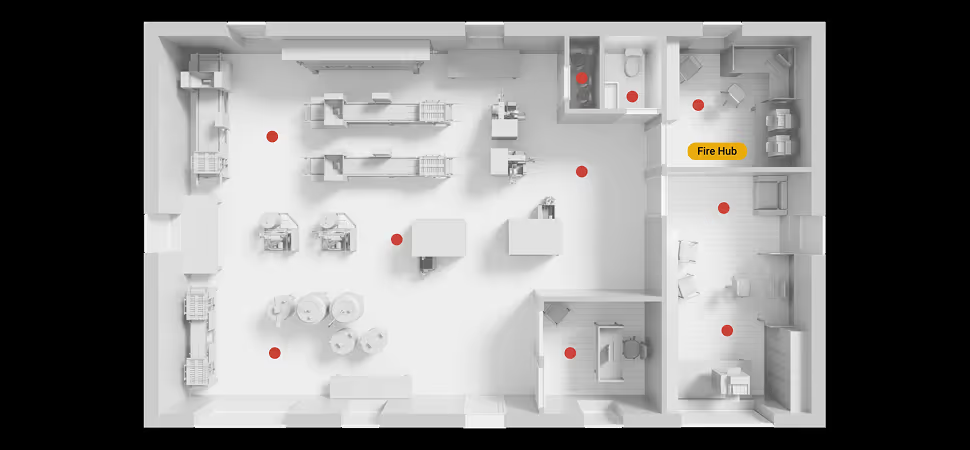
The 2025 edition updates the guidance on maximum spacing between point-type smoke detectors. While the fundamental principles remain the same — spacing is determined by ceiling height, beam depth, and environmental factors — the revised tables provide more granular data for modern office layouts. Open-plan offices with suspended ceilings, partitioned cubicle arrangements, and co-working spaces with variable furniture configurations are now better addressed.
For Taunton offices, particularly those in converted period buildings with irregular ceiling heights and exposed beams, the updated spacing rules may require additional detectors or repositioning of existing devices to maintain compliance.
Updated System Category Guidance
The standard has refined the guidance on selecting the appropriate system category. Categories L1 through L5 and P1/P2 remain the framework, but the 2025 edition provides clearer direction on when a fire risk assessment should recommend stepping up from one category to another. For office premises, the distinction between L3 (escape routes only) and L2 (escape routes plus high-risk areas) has been sharpened, with additional examples relevant to modern office configurations.
New Guidance on Wireless Fire Alarm Devices
Perhaps the most notable addition is expanded coverage of wireless fire alarm technology. The 2017 edition acknowledged wireless systems but provided limited design guidance. The 2025 revision includes detailed recommendations for:
- Signal path reliability and redundancy requirements
- Battery life expectations and replacement schedules for wireless devices
- Co-existence of wireless devices with existing wired infrastructure in hybrid systems
- Site survey requirements specific to wireless installations, including RF interference assessment
This is particularly relevant for Taunton office buildings in listed or heritage structures where running new cable routes may be impractical or restricted by planning conditions.
Enhanced Cause-and-Effect Documentation
The 2025 edition strengthens the requirement for a formal cause-and-effect specification documenting every interaction between the fire alarm system and other building services. For offices, this typically includes door holder release, HVAC shutdown, lift recall, access control override, and alarm transmission to a monitoring centre. The standard now expects this documentation to be maintained as a living document, updated whenever the building use or system configuration changes.
Does Your Taunton Office Need to Upgrade?
A system installed and commissioned to BS 5839-1:2017 does not automatically become non-compliant because a new edition has been published. However, there are several scenarios where an upgrade becomes necessary or strongly advisable:
- Building alterations — Any change to the office layout, partition arrangement, or building use should trigger a review against the current edition of the standard
- Fire risk assessment recommendations — If your fire risk assessor recommends improvements, these should reference the 2025 edition
- System expansion — Adding new zones or devices to an existing system should be designed to the current standard
- Insurance requirements — Some insurers now specify compliance with the latest edition as a condition of cover
- Enforcement action — If the fire authority issues an enforcement or alterations notice, the expectation will be compliance with the current standard
Common Compliance Gaps in Taunton Office Buildings
From our experience surveying and upgrading fire alarm systems in Taunton offices, the most frequently identified compliance gaps include:
- Insufficient detection coverage — Offices that have been repartitioned since installation often have areas where detector coverage is inadequate under the revised spacing rules
- Outdated detector technology — Older ionisation detectors being replaced by multi-sensor devices that offer better discrimination between genuine fire signatures and environmental interference
- Missing or incomplete cause-and-effect documentation — Systems that integrate with door holders, HVAC, or access control but lack a formal cause-and-effect matrix
- No provision for wireless devices — Buildings where cable routing constraints have led to gaps in coverage that could be addressed with wireless technology under the new guidance
- Inadequate log book records — Weekly testing, quarterly inspections, and annual servicing not being recorded consistently
The Upgrade Process: What to Expect
Upgrading a fire alarm system in a Taunton office to meet BS 5839-1:2025 typically follows this process:
- Survey and gap analysis — A qualified fire alarm engineer surveys the premises, reviews the existing system against the 2025 standard, and identifies all areas requiring attention.
- Fire risk assessment review — The current fire risk assessment is reviewed to confirm the required system category and any specific recommendations.
- Design proposal — A detailed design is produced showing proposed changes, including new or repositioned devices, updated zoning or loop architecture, and any wireless elements.
- Installation — Works are carried out with minimal disruption to office operations, typically outside core business hours where possible.
- Commissioning and testing — Every new and existing device is tested, cause-and-effect sequences are verified, and the system is formally commissioned.
- Documentation and handover — Updated as-built drawings, cause-and-effect matrix, commissioning certificate, and log book are provided.
Why Choose Affinity Fire & Security for Fire Alarm Upgrades in Taunton?
We hold BS 5839-1 and British Standards — the highest independent certifications for fire alarm system design, installation, and maintenance. Our local engineers work across Taunton and the wider Somerset region, and we have plenty of practical experience upgrading systems in period office buildings, modern commercial units, and mixed-use premises.
We work with leading manufacturers including Advanced, Apollo, Hochiki, and Kentec, selecting the most appropriate technology for each project rather than defaulting to a single product range. Whether your Taunton office requires a straightforward detector upgrade or a complete system redesign to meet BS 5839-1:2025, our team will deliver a compliant, cost-effective solution.
Get in touch with our team for a free consultation on upgrading your Taunton office fire alarm system to BS 5839-1:2025.
Related Reading
You may also find fire and security for small shops in Bristol and café and takeaway fire alarm requirements useful.
Talk to a Local Engineer
If you would like honest advice, a clear written quote, or help with compliance paperwork,get in touch with our team. We are a small, experienced South West team, and we look after every customer properly — no pushy sales, no hidden extras, and documentation you can rely on.