Almost every compliance problem we are called into starts the same way. The systems are fine. The paperwork isn't. A fire officer asks for the last twelve months of weekly test records and what comes out of the drawer is a red folder with four entries, two of them in the same handwriting a year apart.
That is why every Affinity service contract now comes with a free digital fire safety and security logbook, opened by scanning a QR code on the wall. This is what it does, what the law actually asks of you, and why we decided to give it away rather than sell it.
What the Law Expects You to Keep
Under the Regulatory Reform (Fire Safety) Order 2005, the responsible person for a commercial premises must make sure fire safety equipment is maintained in efficient working order and in good repair — and must be able to show it. In practice, an inspecting officer, insurer or fire risk assessor will ask to see:
- The current fire risk assessment and its action plan.
- Weekly manual call point tests, rotating the device used, as recommended by BS 5839-1.
- Monthly function tests and annual three-hour duration tests for emergency lighting under BS 5266.
- Service and commissioning certificates for the fire alarm, extinguishers and suppression.
- A record of faults found, what was done about them, and when.
- Staff training and evacuation drill records.
Nothing in that list says "paper". The Fire Safety (England) Regulations 2022 pushed things further the other way for higher-risk residential buildings, expecting information to be shared electronically with fire and rescue services. Digital records are not a shortcut — they are simply the version that is still complete two years later.
Where Paper Logbooks Fall Down
We are not sniffy about the red folder. It worked for decades. But we see the same four failures over and over:
- It goes missing. Refits, new managers, a builder moving things — and the history of the building goes with it.
- It only exists in one place. If the folder lives at reception, the area manager forty miles away has no idea whether last week's test happened.
- Gaps appear quietly. Nobody notices three missed weeks until an inspection, and by then there is no way to put them right honestly.
- Certificates end up in email. The service report was sent to someone who has since left, and nobody can produce it.
None of those are equipment problems. They are admin problems, and admin problems are the ones that turn into enforcement notices and refused insurance claims.
How the QR Logbook Works
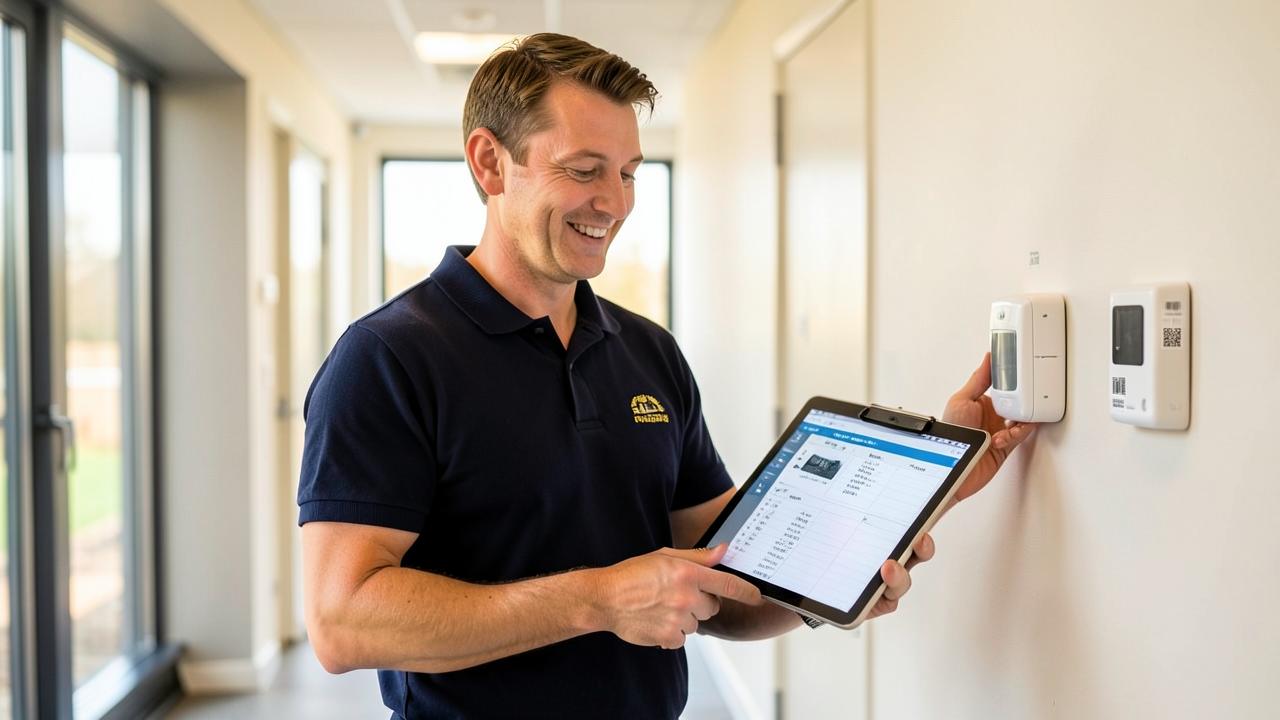
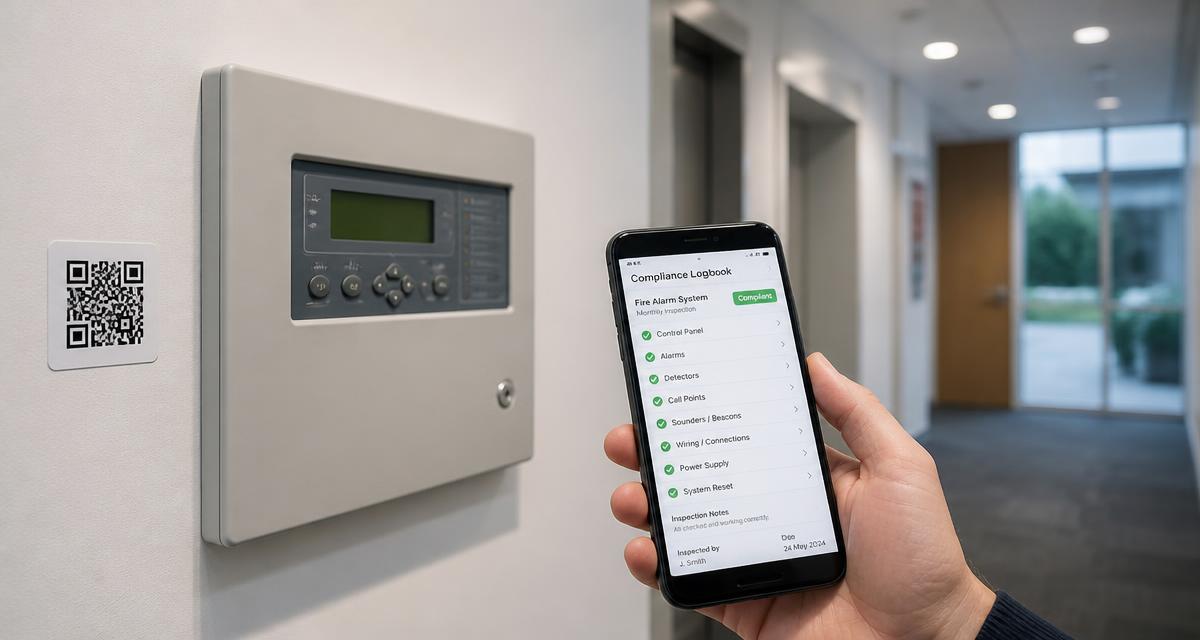
When your contract starts, we fit a small QR label beside the fire alarm panel — and anywhere else that makes sense, such as reception or the plant room. From there:
- Anyone authorised scans it with a phone camera. There is no app to install and nothing to remember. The record for that specific building opens.
- Weekly and monthly checks are logged in seconds. Pick the call point tested, confirm the sounders operated, add a note if something was odd. Date, time and name are recorded automatically.
- Our visits file themselves. Every service report, certificate and asset update we produce lands in the same place, so the record never drifts out of date.
- Remedials are tracked openly. Faults are logged with a photo, a plain-English explanation and a fixed price, so you can see exactly what is outstanding and what it costs.
For a fire officer or auditor, the whole visit becomes: scan, scroll, done. For you, it becomes one less thing to chase.
Weekly and Monthly Compliance Reporting
The logbook only helps if someone reads it, so we send the summary to you rather than waiting for you to log in. Contract customers choose weekly, monthly or both:
- Weekly snapshot — did the call point test happen, which zone was used, and is anything still open from last week. Useful where duty staff rotate, such as schools, care settings and hospitality.
- Monthly compliance report — a one-page position for each site covering tests completed, services due, certificate expiry dates and open defects by priority. It is written to be forwarded straight to an insurer, landlord or fire risk assessor.
- Portfolio roll-up — for multi-site customers, one view showing which buildings are green and which need attention this month.
Who It Suits
Honestly, everyone we look after — but the difference is biggest for:
- Independent shops, cafés and small offices where the owner is also the responsible person and has no time to run a filing system. See our guide to fire and security for small shops in Bristol.
- Schools, care homes and community buildings where several people share the weekly testing duty and continuity matters.
- Landlords and managing agents who need to evidence compliance across a portfolio without visiting every site.
- Anyone who has just taken over a building and inherited no records at all — we start the history from the survey.
Why We Give It Away
Plenty of companies sell compliance software as an extra line on the invoice. We looked at that and decided against it. Our engineers were already losing time hunting for the last service report, and our customers were already paying for that time somewhere. Putting the records where everyone can see them makes the whole job cheaper to run, so it belongs in the contract, not on top of it.
It is also a fair test of us. If the reports show we have missed a visit, you will see it. That suits how Adam and Jack want to run the company — the same reason we keep the team small and turn up ourselves.
Frequently Asked Questions
Is a digital fire logbook legally acceptable in the UK?
Yes. The Regulatory Reform (Fire Safety) Order 2005 requires the responsible person to record the findings of the fire risk assessment and keep records of testing and maintenance, but it does not say those records must be on paper. A digital logbook is acceptable — and usually easier to produce during an inspection — provided the entries are accurate, dated, attributable to a named person and available on request.
What tests do I still have to do myself?
A contract does not remove the weekly duties. Under BS 5839-1 the responsible person should test a manual call point weekly, rotating the point used, and record the result. Emergency lighting under BS 5266 needs a monthly short-duration function test. Our logbook prompts both, records who did them and flags anything missed — but the tests themselves are still yours to carry out.
How does the QR code work if the building has no Wi-Fi?
Scanning uses the phone's normal mobile data, so it works anywhere with a signal. In basements or plant rooms with no reception, staff can scan on the way in and complete the entry once they are back in range. Nothing is lost, and the entry keeps the time the check was carried out.
Who can see our records?
Only the people you nominate, plus our engineers. You decide whether the site manager, caretaker, landlord or fire risk assessor gets access, and you can add or remove people at any time. Records are held securely and are never shared with anyone else.
Is the digital logbook really free?
It is included with any Affinity service contract at no additional cost — no licence fee, no per-user charge and no minimum number of sites. We built it because chasing missing paperwork wasted our engineers' time as much as our customers'.
What happens to our records if we leave?
They are your records, not ours. If you ever move to another maintainer we will export everything — certificates, service reports, asset registers and test history — and hand it over in a standard format. There is no lock-in.
Getting Set Up
Setting up takes one survey. We list the systems on site, agree a visit schedule, build your asset register, print the QR labels and load whatever historic certificates you already hold. From the first visit onwards the record maintains itself.
Full details of what each contract includes are on our service contracts page, and the engineering side is covered under maintenance and remedials. If you would like a price, ask for a maintenance quote or get in touch and speak to one of us directly.