Emergency Voice Communication Systems (EVCS) and disabled refuge alarms are a legal requirement in most multi-storey commercial buildings, yet they remain one of the most frequently overlooked fire safety obligations. For Swindon building owners and managers and responsible persons, failure to install, maintain, or test a compliant system under BS 5839-9 can result in enforcement action, prosecution, and — most critically — the inability to safely evacuate disabled occupants in a fire emergency.
What Is BS 5839-9?
BS 5839-9:2021 is the British Standard that specifies the design, installation, commissioning, and maintenance of emergency voice communication systems used in buildings. It covers two-way speech communication between refuge areas (or other locations where disabled persons may wait for assisted evacuation) and a central control point — typically the fire alarm panel location or building entrance where the fire and rescue service will attend.
The standard works alongside BS 5839-1 (fire detection and alarm) and the Regulatory Reform (Fire Safety) Order 2005 to ensure that buildings provide an inclusive evacuation strategy for all occupants, including those with mobility impairments, wheelchair users, and anyone unable to use stairs unaided during an emergency.
When Is an EVCS Legally Required?
The requirement for an EVCS or disabled refuge alarm system is determined by the fire risk assessment and Building Regulations Approved Document B. In practice, an EVCS is required in virtually all multi-storey buildings where:
- Refuge areas are provided — Any building with designated refuge points on escape stairs or in protected lobbies requires two-way communication between those refuges and a master station
- The building has more than one storey — Approved Document B requires refuges on every storey served by a protected stairway in most building types
- Lifts are designated as evacuation lifts — BS 9999 and Approved Document B require communication systems for evacuation lift lobbies
- The building serves the public — Offices, retail, healthcare, education, leisure, and government buildings in Swindon must all provide for disabled evacuation
- The Equality Act 2010 applies — Service providers and employers have a duty to make reasonable adjustments for disabled persons, which extends to emergency evacuation arrangements
In Swindon, this affects a broad range of commercial properties — from the town centre offices around Fleming Way and Regent Circus to the industrial and distribution premises along the A419 corridor and Great Western Way business parks.
How an EVCS Works
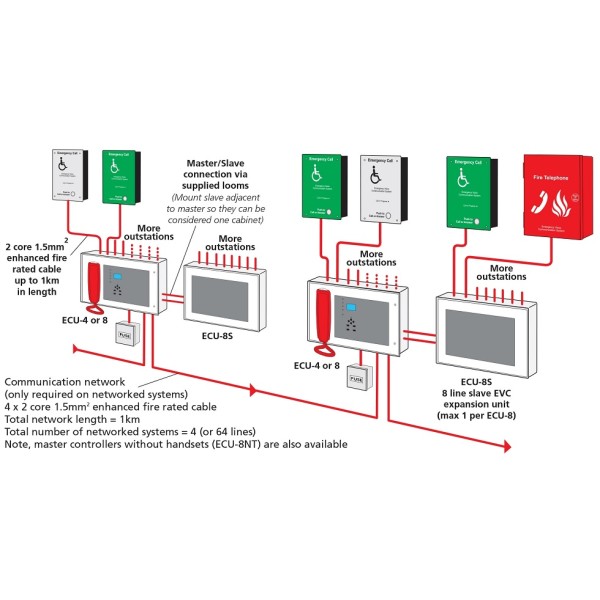
A BS 5839-9-compliant EVCS consists of interconnected components that enable reliable two-way voice communication during an emergency:
- Refuge outstations — Wall-mounted communication units installed at each designated refuge point. These feature a clearly marked call button, a built-in speaker and microphone, and visual indicators showing call status. Type A outstations are for general use; Type B outstations include an inductive coupler for hearing aid users
- Master station — The central control unit, typically located at the building's fire alarm panel or the fire and rescue service access point. This allows the operator to communicate with any refuge outstation, prioritise calls, and coordinate the evacuation of disabled occupants
- Fire-resistant cabling — All wiring between outstations and the master station must use fire-resistant cable meeting BS 7629-1 or BS 8434-2, ensuring the system remains operational during a fire
- Battery backup — The system must maintain full operation for a minimum of 3 hours on standby plus 30 minutes of full-load operation on battery power alone
- Visual indication — Each outstation must have a visible LED indicator confirming the call has been received, providing reassurance to the waiting occupant
EVCS vs Disabled Refuge Alarm: What's the Difference?
The terms are often used interchangeably, but there is a technical distinction:
| Feature | Disabled Refuge Alarm | EVCS (BS 5839-9) |
|---|---|---|
| Communication | One-way alert (call button only) | Full two-way voice communication |
| BS 5839-9 compliance | Does not meet the standard | Fully compliant |
| Reassurance | Limited — occupant presses button and waits | Full — operator can speak directly to the occupant |
| Information exchange | None — operator cannot assess the situation | Operator can assess condition, give instructions, prioritise rescue |
| Current requirement | Being phased out in favour of EVCS | Required by BS 5839-9 and Approved Document B |
If your Swindon building has an older one-way refuge alarm system, it is likely non-compliant with current standards and should be upgraded to a full EVCS.
Design Considerations for Swindon Buildings
Designing an EVCS for Swindon commercial premises requires careful planning:
- Refuge location identification — Every protected stairway and protected lobby on each storey must be assessed for refuge provision. The refuge must provide a minimum clear space of 900mm × 1400mm for a wheelchair
- Master station positioning — The master station should be located where building management or the fire and rescue service will attend during an emergency. For buildings with a permanently staffed reception, this is typically the reception desk. For unstaffed buildings, it should be at the fire alarm panel near the main entrance
- Integration with fire alarm systems — The EVCS can be configured to activate automatically when the fire alarm operates, or to function independently. The cause-and-effect specification must be coordinated with the building's overall fire alarm design
- Hearing loop compatibility — Type B outstations with inductive couplers must be installed where hearing aid users may need to use the system. This is a requirement under the Equality Act 2010 as well as BS 5839-9
- Signage — Each refuge point must be clearly identified with compliant signage indicating the location of the outstation and instructions for use
- Integration with emergency lighting — Refuge areas must be adequately illuminated under emergency lighting conditions to enable the occupant to locate and operate the outstation
Common Compliance Failures We Find in Swindon
During compliance audits, our engineers frequently identify the following EVCS and refuge alarm issues:
- No system installed — The most basic failure. Many older Swindon commercial buildings were constructed before current standards and have never had an EVCS retrofitted
- One-way systems — Older refuge alarm systems that provide a call button but no two-way voice communication do not meet BS 5839-9
- Untested systems — EVCS that have never been tested since installation. BS 5839-9 requires regular testing and maintenance
- Faulty outstations — Outstations with failed speakers, microphones, or call buttons that have not been identified because the system is not included in the building's fire alarm maintenance contract
- Missing refuges — Buildings where refuge areas have been removed or repurposed during refurbishment without updating the EVCS
- No Personal Emergency Evacuation Plans (PEEPs) — The EVCS is only effective if the building has documented PEEPs for disabled occupants and staff are trained in assisted evacuation procedures
Installation Process
- Site survey and fire risk assessment review — Identifying all required refuge locations, master station position, cable routes, and integration requirements with the existing fire alarm system
- System design — Producing layout drawings, wiring schematics, and a specification compliant with BS 5839-9:2021
- Equipment selection — Specifying appropriate outstations (Type A or Type B), master station capacity, and cabling type based on the building's fire resistance requirements
- Installation — Running fire-resistant cabling, mounting outstations at each refuge, installing the master station, and connecting battery backup
- Commissioning — Testing two-way communication at every outstation, verifying speech clarity, checking LED indicators, confirming battery backup duration, and testing any fire alarm integration
- Handover — Providing commissioning certificates, as-built drawings, BS 5839-9 certificate of compliance, operating instructions, and staff training on system use
Maintenance Requirements Under BS 5839-9
BS 5839-9 specifies a clear maintenance regime:
- Weekly testing — Functional test of at least one outstation per week on a rotational basis, verifying two-way speech clarity and call indication
- Quarterly inspections — A competent person should inspect the system, test battery backup, and verify all outstations are operational
- Annual servicing — Full inspection and test of every component by a qualified contractor. This should be carried out by an competent contractor working to BS 5839-1
- Record keeping — All testing and maintenance must be documented in a log book, available for inspection by the fire authority
We provide planned preventative maintenance contracts that include EVCS servicing alongside your fire alarm maintenance programme, ensuring nothing is missed.
Penalties for Non-Compliance
Failure to provide a compliant EVCS where required exposes the responsible person to:
- Enforcement notices from Dorset & Wiltshire Fire and Rescue Service requiring remedial action within a specified timeframe
- Prohibition notices restricting building occupation until the system is installed
- Criminal prosecution under the Fire Safety Order with unlimited fines
- Equality Act claims from disabled employees or building users who have been denied reasonable adjustments for emergency evacuation
- Insurance invalidation where non-compliance with statutory fire safety requirements voids cover
Why Choose Affinity Fire & Security for EVCS Installation in Swindon?
As a specialist contractor working to BS 5839-1, backed by a team with 25+ years of industry experience, We design and installs BS 5839-9-compliant EVCS and disabled refuge systems across Swindon and Wiltshire. We integrate EVCS with your existing fire alarm, emergency lighting, and smoke ventilation systems for a coordinated life safety solution.
Whether you need a new EVCS installation, an upgrade from a legacy one-way refuge alarm, or a compliance audit of your existing system, our qualified engineers will ensure your Swindon building meets its legal obligations and protects all occupants equally.
Get in touch with our team for a free, no-obligation site survey and quotation for EVCS and disabled refuge alarm installation in Swindon and across Wiltshire.
Talk to a Local Engineer
If you would like honest advice, a clear written quote, or help with compliance paperwork,get in touch with our team. We are a small, experienced South West team, and we look after every customer properly — no pushy sales, no hidden extras, and documentation you can rely on.