Public Address & Voice Alarm (PA/VA) and Emergency Voice Communication Systems (EVCS) have traditionally been installed as two entirely separate life-safety networks — each with its own panels, fire-rated cabling, containment and certification regime. With the latest generation of converged voice systems, that duplication is no longer necessary. The Vox Ignis Unicorn Voice platform allows a single fire-rated network bus to carry BS 5839-8 PA/VA, BS 5839-9 EVCS and BS 8300 assistance alarms simultaneously — typically reducing cable mileage, containment and on-site labour by 30–50% on a new build.
Why PA/VA and EVCS Were Historically Separate
For decades, voice alarm and emergency voice communication were specified by different consultants, designed against different British Standards, and delivered by different sub-contractors:
- PA/VA — broadcast loudspeaker network for evacuation messages and live announcements, designed to BS 5839-8 and EN 54-16/EN 54-24, typically using 100V line speaker circuits and a dedicated amplifier rack
- EVCS — two-way speech between refuge outstations, fire telephones and a master station, designed to BS 5839-9, typically using a separate 4-wire fire-rated bus back to a stand-alone EVCS panel
- Assistance alarms — disabled toilet alarms and assist-call points to BS 8300, almost always installed as a third, completely independent system
Three systems meant three sets of risers, three certification packs, three sets of batteries, and three maintenance contracts — all doing fundamentally the same job: getting voice between the fire alarm panel location and occupants somewhere else in the building.
The Converged Network Approach
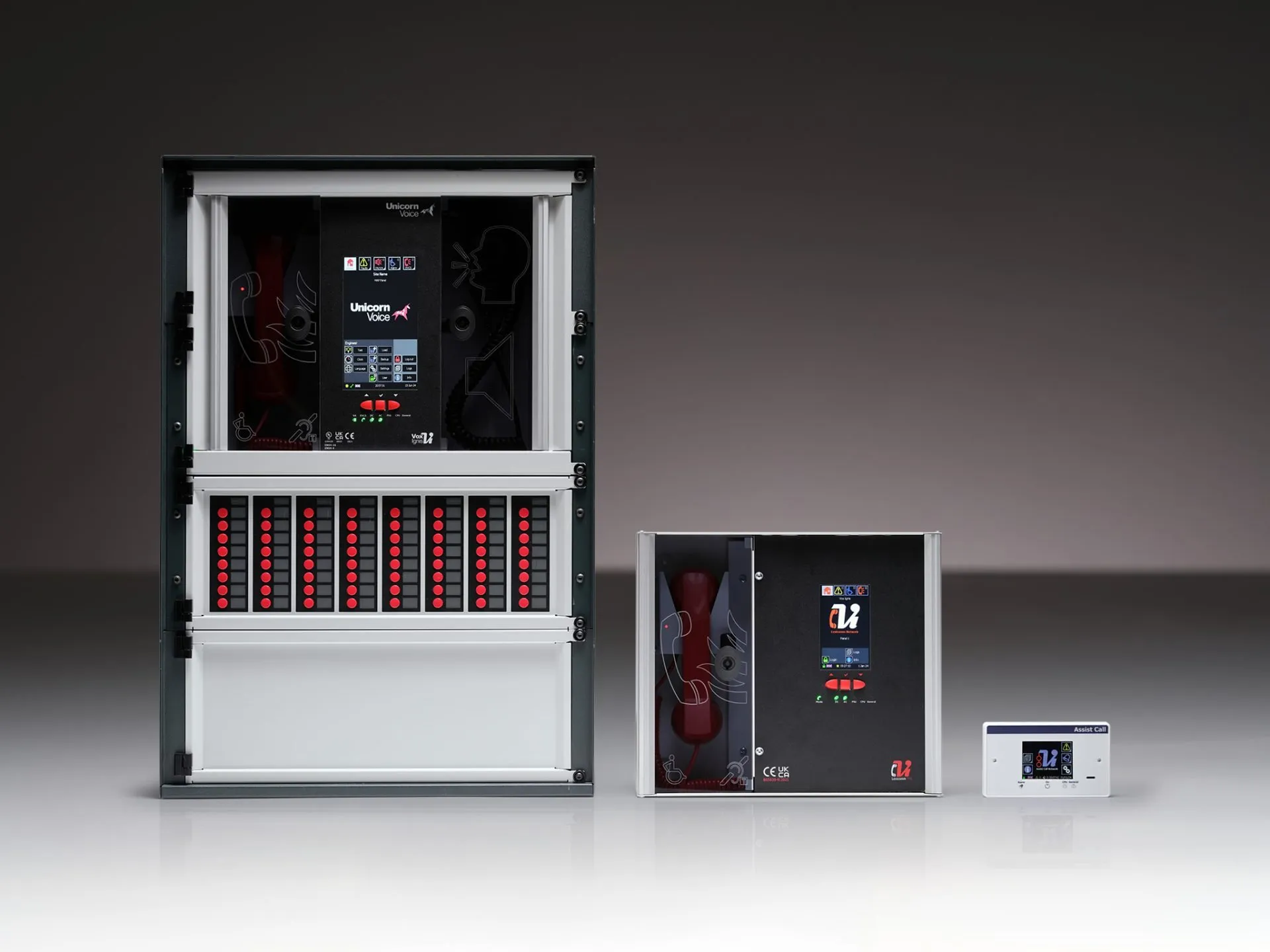
Vox Ignis Unicorn Voice and the matching LexiCommPro EVCS panels share a common digital bus architecture. PAVA loudspeaker controllers, EVCS refuge outstations, fire telephone outstations and Assist Call points all sit on the same fire-resistant network — typically a single Enhanced fire-rated cable (BS 7629-1 / BS 8434-2) looped between distributed nodes around the building.
Each device on the bus is individually addressed and supervised end-to-end. Audio for PA/VA broadcast and the dedicated speech channels for EVCS conversations are carried over the same physical pair, but logically segregated and prioritised in firmware so that an active EVCS call cannot be interrupted by a routine PA announcement, and a fire-triggered evacuation message takes priority over both.
Where the Cost Savings Come From
On a typical 6-storey commercial building, splitting the PAVA, EVCS and assist-call systems onto a single Vox Ignis network removes a significant amount of duplicated infrastructure. The savings are not theoretical — they show up in every section of the tender:
| Cost Area | Traditional 3-System Approach | Converged Vox Ignis Network |
|---|---|---|
| Fire-rated cabling | Three separate fire-rated bus circuits riser-to-floor | Single shared fire-rated loop |
| Containment & tray | Three sets of segregated containment | One containment route |
| Panels & enclosures | PAVA rack + EVCS panel + assist-call PSU | Unicorn Voice master + distributed nodes |
| Battery backup | Three independent battery sets | Single shared battery system |
| Commissioning | Three separate commissioning visits & cert packs | Single coordinated commissioning |
| Maintenance contract | Three service regimes, often three contractors | One unified maintenance contract |
1. Fire-Rated Cable & Containment
Fire-resistant cable to BS 7629-1 or enhanced PH120 cable to BS 8434-2 is one of the most expensive consumables on a fire and life-safety job. Combining PAVA, EVCS and assist-call onto a single shared bus eliminates two of the three riser cable runs and the associated cable tray, fire-stopping and labour for pulling-in. On larger sites the cabling reduction alone can fund a substantial portion of the panel hardware.
2. Panel Hardware & Battery Plant
A traditional installation requires a PAVA amplifier rack, a separate EVCS master panel, a separate assist-call controller and three independent battery sets sized for full BS 5839-8/9 standby and alarm load. With Vox Ignis Unicorn Voice, the master panel and distributed network nodes carry all three functions, sharing a single battery plant — reducing both capital cost and the floor area required in the comms or fire panel room.
3. Coordination & Programme Risk
On a multi-trade site, coordinating three different specialist sub-contractors around the M&E programme is a major source of delay and cost variation. A single converged network is delivered by one fire and life-safety contractor, with one cause-and-effect matrix, one set of as-built drawings and a single point of accountability for compliance with BS 5839.
4. Long-Term Maintenance
Once handed over, the building only needs one annual service regime instead of three. We provide planned preventative maintenance contracts that cover the entire converged voice system in a single visit, with one log book, one certificate and one set of engineer call-out charges — reducing lifetime cost of ownership over the typical 15–20 year system life.
Compliance — Single Cable Does Not Mean Compromised Standards
A common (and reasonable) question from fire risk assessors is whether sharing infrastructure compromises the independence required by the standards. It does not. The Vox Ignis architecture is third-party certified to:
- EN 54-16 — Voice alarm control and indicating equipment
- EN 54-24 — Loudspeakers for voice alarm systems
- BS 5839-8 — Code of practice for the design, installation, commissioning and maintenance of voice alarm systems
- BS 5839-9 — Code of practice for the design, installation, commissioning and maintenance of emergency voice communication systems
- BS 8300 — Design of an accessible and inclusive built environment, for assist-call and disabled refuge functions
Each function on the bus is logically segregated, individually monitored and prioritised in firmware. Cable monitoring detects open and short-circuit faults on every leg of the loop, and a single cable fault cannot disable both PAVA and EVCS coverage thanks to the dual-path loop topology required by the standards.
Where Convergence Makes the Biggest Difference
The cost case for a converged Unicorn Voice network is strongest on:
- Multi-storey commercial offices in Bristol, Bath and Swindon, where refuges are required on every floor and PAVA is specified for phased evacuation
- Education and healthcare buildings, which combine PAVA messaging with multiple disabled refuges and assist-call points
- Retail, leisure and stadia, where live PA, automated voice alarm and EVCS provision must be delivered as a single coordinated solution
- High-rise residential and student accommodation, where recent regulatory changes are driving combined fire detection, PAVA and EVCS upgrades
- Refurbishment projects where pulling three new fire-rated cable systems through an occupied building is impractical
Design Process at Affinity Fire & Security
- Site survey & stakeholder review — capturing PAVA zoning requirements, refuge locations, assist-call positions and fire alarm cause-and-effect from the existing fire alarm system
- Network topology design — laying out the shared fire-rated loop, distributed nodes and battery plant against the building risers
- Acoustic modelling — verifying STI-PA speech intelligibility for every PAVA zone in line with BS 5839-8
- Specification & tender documentation — one consolidated specification covering BS 5839-8, BS 5839-9 and BS 8300 instead of three separate packages
- Installation — delivered by Affinity Fire & Security engineers, fully coordinated with the M&E programme
- Commissioning & certification — combined commissioning visit with a single certificate pack covering PAVA, EVCS and assist-call functions
- Handover & training — building management trained on a single user interface for all voice life-safety functions
Why Specify Vox Ignis with Affinity Fire & Security
We are an approved Vox Ignis design and installation partner, delivering converged Unicorn Voice and LexiCommPro systems across Bristol and the South West. As a specialist contractor working to BS 5839-1, backed by a team with 25+ years of industry experience in fire alarm, EVCS and PAVA design, we bring all three disciplines under one roof — exactly mirroring the converged technology we install.
If you are budgeting a new fire and life-safety scheme, refurbishing an existing PAVA installation, or upgrading legacy refuge and assist-call alarms, get in touch with our team for a converged Vox Ignis design proposal. We will demonstrate the cabling, containment and lifecycle savings against a traditional three-system approach with a fully costed comparison.
Talk to a Local Engineer
If you would like honest advice, a clear written quote, or help with compliance paperwork,get in touch with our team. We are a small, experienced South West team, and we look after every customer properly — no pushy sales, no hidden extras, and documentation you can rely on.